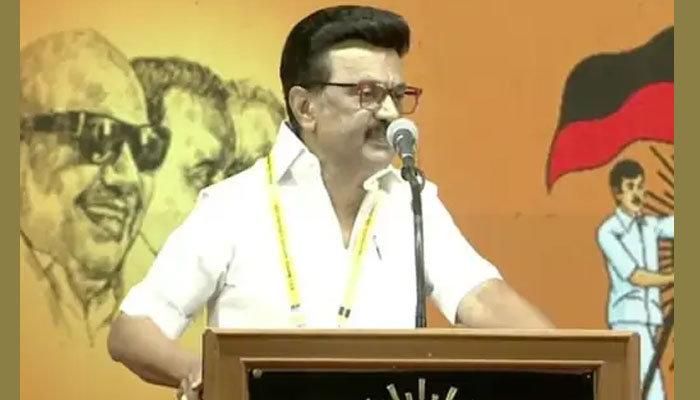
Chennai/Alive News: Dravida Munnetra Kazhagam (DMK) president and former Tamil Nadu Chief Minister M.K. Stalin has made it clear that his party will not compromise on its demands regarding the proposed delimitation exercise. He has insisted that Tamil Nadu’s existing share of 7.18% in the Lok Sabha must not be reduced under any circumstances.
Stalin’s statement comes amid growing political debate over delimitation and allegations by the ruling Tamilaga Vettri Kazhagam (TVK) that the DMK could be moving closer to the BJP. His remarks are also aimed at ending speculation about a possible change in the DMK’s position.
In a strong statement, Stalin said the party would continue to protect Tamil Nadu’s interests and would not abandon its principles for political gains or positions of power.
“The DMK will never compromise on Tamil Nadu’s interests. Nor will it move away from its principles,” he said.
DMK Repeats Two Major Demands on Delimitation
Stalin said the DMK was among the first political parties in the country to raise concerns about the possible impact of delimitation on states such as Tamil Nadu.
He recalled that Chennai hosted the first meeting of national political leaders who came together to demand a fair delimitation exercise.
Referring to the resolutions passed by the Tamil Nadu Legislative Assembly and the Joint Action Committee on fair delimitation, Stalin repeated two major demands.
First, even if the total number of Lok Sabha seats is increased, Tamil Nadu’s existing share of 7.18% must not be reduced.
Second, the proportion of parliamentary representation among states, based on the 1971 Census, must remain unchanged for another 25 years.
The DMK argues that states which have successfully controlled population growth should not lose their share of parliamentary representation because of changes based on population figures.
Stalin said the party remained firm on both demands and there was no question of changing its position.
“There is no change in our stand, and there is no question of compromise,” he asserted.
Why Delimitation Has Become a Major Political Issue
Delimitation is the process of redrawing the boundaries of Lok Sabha and Assembly constituencies. It also determines how many parliamentary seats each state gets.
The issue is particularly sensitive in southern states such as Tamil Nadu, Kerala, Karnataka, Andhra Pradesh and Telangana. These states fear that their share of seats in Parliament could decline if representation is redistributed mainly on the basis of population.
They argue that states which have controlled population growth should not be disadvantaged in terms of political representation.
Under the constitutional framework, the allocation of Lok Sabha seats among states was frozen on the basis of the 1971 Census through the 42nd Constitutional Amendment in 1976. The 84th Constitutional Amendment in 2001 extended this arrangement until the first Census conducted after 2026.
The 87th Constitutional Amendment in 2003 allowed constituency boundaries to be redrawn using the 2001 Census without changing the total number of seats allocated to each state.
With the existing freeze linked to the first Census after 2026, the question of future delimitation has become an important political issue. Southern states are demanding safeguards to protect their representation in Parliament.
Stalin Targets Political Opponents
Stalin also criticised political opponents who, according to him, had abandoned their principles for positions of power.
Dismissing media reports and political criticism, he said such attempts would not weaken the DMK’s position on delimitation.
Taking a sharp dig at those he described as ungrateful and backstabbers, Stalin said people who gave up their principles for political power should understand that the DMK would not follow the same path.
He reiterated that protecting Tamil Nadu’s interests would remain the party’s priority and that it would not change its position on the delimitation issue.