

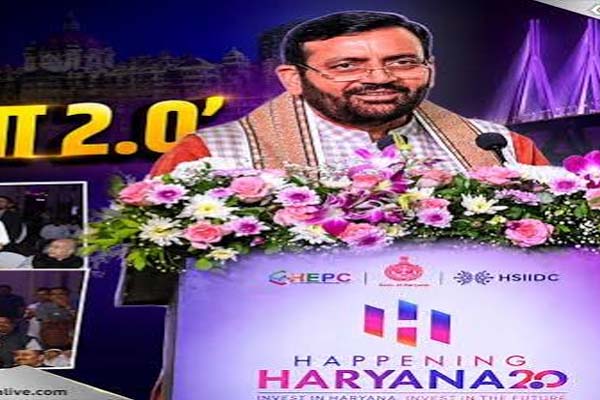
Chandigarh/Alive News: Haryana Chief Minister Nayab Singh Saini is seeking to broaden the state’s industrial growth beyond major cities and established industrial hubs, with a focus on attracting fresh investment, generating employment and creating entrepreneurial opportunities for young people. The roadshows planned in Surat and Ahmedabad under Happening Haryana 2.0 are part of this effort to engage industry leaders and investors and showcase Haryana as a destination for business expansion.
The initiative aims to go beyond attracting large industrial projects and ensure that the benefits of investment reach local entrepreneurs, small businesses and micro, small and medium enterprises (MSMEs). The broader objective is to translate fresh investment into local employment, business opportunities for smaller enterprises and a stronger entrepreneurial ecosystem in the state.
Investment Push to Focus on Jobs and Local Enterprise
Under Saini’s leadership, the state’s investment outreach is being positioned as a means to expand employment opportunities and strengthen industrial activity across different regions of Haryana. New industrial units could create jobs for local youth, increase demand for skilled workers and open up new markets for small businesses.
A key priority will be to develop local supplier and vendor networks alongside large industrial projects. Manufacturing companies require a range of supporting goods and services, including components, packaging materials, engineering products, electrical equipment, machining, fabrication and logistics.
Integrating Haryana-based businesses into these supply chains could help local entrepreneurs secure business from larger industrial buyers. This would allow the benefits of industrial investment to extend beyond individual companies and established industrial centres to surrounding communities and local economies.
Opportunities for Youth in Manufacturing
Industrial expansion could also enable young people in Haryana to move beyond conventional employment and establish businesses supplying products, components and services to large manufacturers.
However, this would require effective collaboration between major industries and local MSMEs. Access to technical training, quality certification, financing, industry-specific skills and timely payments would be crucial to helping smaller enterprises meet the requirements of large buyers.
Stronger linkages between manufacturers and local vendors could help small businesses enter established supply chains, expand their operations and create additional employment. Enabling young entrepreneurs to participate in manufacturing would therefore be an important step towards making industrial growth more inclusive.
Surat and Ahmedabad Roadshows to Explore Investment Opportunities
Through the roadshows in Gujarat’s key commercial centres, Surat and Ahmedabad, Saini is expected to interact with industry representatives and investors to explore opportunities for investment and business expansion in Haryana.
The state’s proximity to the National Capital Region (NCR), connectivity, established industrial base, skilled workforce and access to major markets are among the factors that could strengthen its appeal to investors.
Fresh industrial investment could stimulate economic activity across different parts of Haryana while generating demand for local suppliers, transport operators, small manufacturing units and ancillary service providers. The extent of these benefits, however, will depend on how effectively new projects are linked with local businesses and workers.
From MoUs to Ground-Level Results
The success of the investment initiative will ultimately depend on how many proposals translate into operational projects, how much employment is generated and how effectively local businesses participate in the resulting economic activity.
Alongside investor outreach, the implementation of memorandums of understanding (MoUs), monitoring of project progress and the integration of local MSMEs into industrial supply chains will be critical.
Investment announcements alone cannot guarantee sustained economic benefits. Their impact will need to be assessed through projects taking shape on the ground, jobs created, orders secured by local enterprises and opportunities made available to first-time entrepreneurs.
If new industrial units generate employment, large manufacturers source goods and services from local vendors, and young entrepreneurs gain access to manufacturing opportunities, the investment drive could have a wider impact on Haryana’s economy.
Building a More Inclusive Industrial Economy
The key test for Haryana’s industrial development will be whether investment opportunities reach regions beyond established industrial centres and translate into tangible benefits for local communities.
The Gujarat roadshows under Happening Haryana 2.0 provide an opportunity for the state to attract investors, explore industrial expansion and strengthen the links between large businesses, local enterprises and young entrepreneurs.
The long-term impact of the initiative will depend not only on the scale of investment attracted but also on its ability to generate jobs, expand business opportunities for MSMEs and encourage young people to become job creators rather than job seekers. Connecting industrial growth with wider economic participation will be central to ensuring that the benefits of investment are shared across Haryana.