
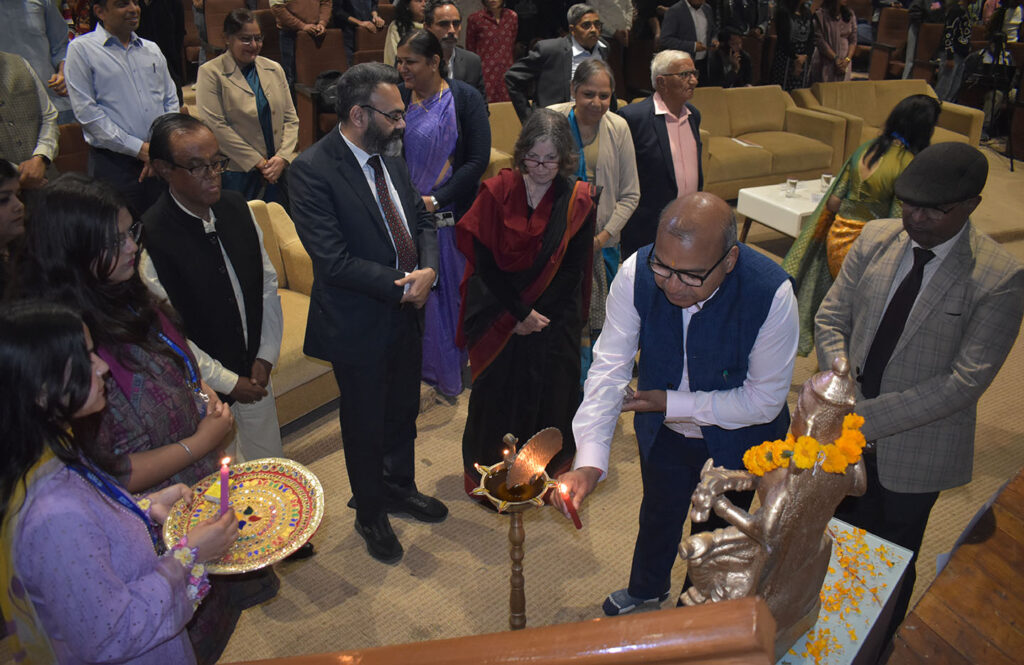
Faridabad/Alive News: The two-day international conference titled “Transmedia Storytelling: Narratives, Discourse and Dissemination” (TS’26), organized by the Department of Literature and Languages at J.C. Bose University of Science and Technology, YMCA, Faridabad, was inaugurated today in the university auditorium. The event is being held in hybrid mode, enabling scholars from India and abroad to participate both offline and online.
The inaugural session was graced by Prof. Bhim Singh Dahiya, former Vice-Chancellor of Kurukshetra University, as the Chief Guest. He described the conference as highly innovative and a significant step forward in contemporary academic discourse. The keynote speaker was Prof. Margit Koves (Visiting Professor, Department of Slavonic and Finno-Ugrian Studies, University of Delhi), while the presidential address was delivered by Prof. Prasannanshu (Director, Centre for Linguistic Justice and Endangered Languages, National Law University, Dwarka).
On this occasion, Vice-Chancellor Prof. Rajive Kumar hailed the conference as a distinctive academic initiative and commended the department’s efforts. He emphasized that the global participation in this hybrid format strengthens the university’s commitment to academic excellence.
Keynote speaker Prof. Margit Koves presented an in-depth review of László Krasznahorkai’s literary works. Through novels such as Satantango, The Melancholy of Resistance, The Turin Horse, and War and War, she elucidated the complex interplay between literature, cinema, and philosophy.
Registrar Prof. (Dr.) Ajay Ranga, in his address, delivered an insightful talk on the social and legal aspects of transmedia storytelling. He explained how transmedia narratives, spread across platforms like books, films, social media, videos, podcasts, and more, reshape societal stories, influence public opinion, drive social trends, and impact mandates such as policies, ethics, and cultural norms.
In his presidential remarks, Prof. Prasannanshu described transmedia storytelling as a transformative narrative practice in the digital age. He stressed the need for interdisciplinary dialogue across literature, media, culture, and technology, calling for collaborative academic engagement in diverse global perspectives and emerging media landscapes.
During the plenary session, Prof. David Blumenkrantz (California State University, USA) spoke on the theme “Reclaiming Agency”, highlighting how photography has historically influenced power structures through colonial perspectives, Western media frameworks, and human narratives. He critically examined concepts like ‘visual imperialism’, ‘imperial gaze’, and ‘photographic truth’, underscoring how images construct meaning and how photography can serve as a medium for reclaiming dignity, context, and representation.
Prof. Ahmar Mahboob (University of Sydney, Australia) addressed “The Amplifier: A Transmedia Journal as Subaltern Practice”, explaining how transmedia platforms empower marginalized voices by providing spaces for knowledge, identity, and resistance. He described digital storytelling and multi-media research as crucial steps toward more inclusive and participatory intellectual structures. The session also featured inputs from Prof. Nibir K. Ghosh (UGC Emeritus Professor, Agra College, Agra).
A total of 40 research papers were presented in hybrid mode on the first day of the conference. The event’s major highlight was a photo exhibition and a captivating cultural performance of the folk singing “Jhoolna”, which beautifully connected academic discussions with cultural sensitivity and Indian folk traditions, adding an emotional and cultural dimension to the intellectual atmosphere.