
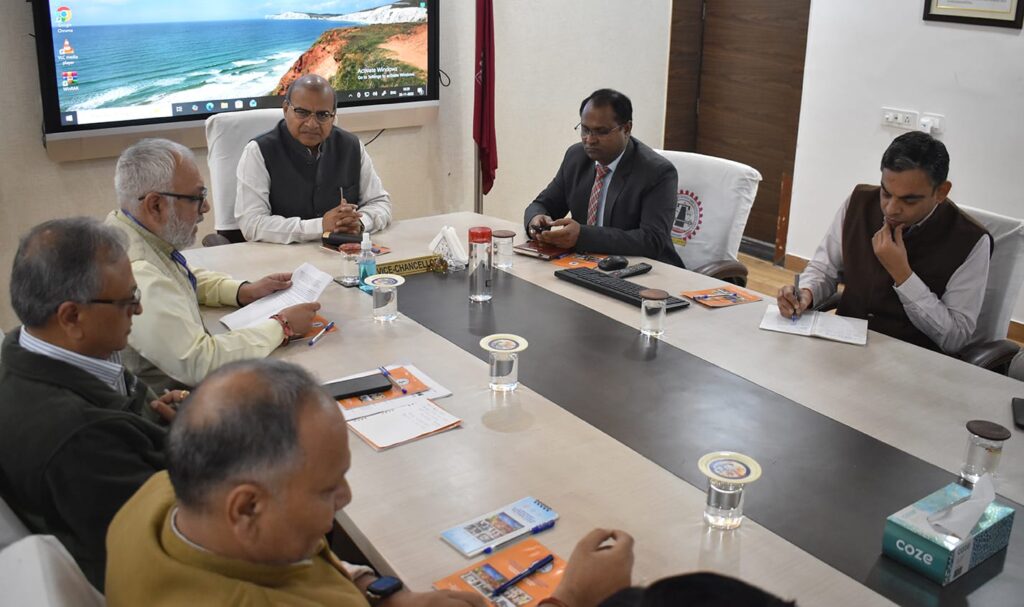
Faridabad/Alive News: In a major step towards strengthening academic quality and implementing the National Education Policy (NEP) 2020, Vice-Chancellor Prof. Rajive Kumar of J.C. Bose University of Science and Technology, YMCA, Faridabad, held his first formal meeting with the Directors and Principals of all affiliated colleges on 25 November.
During the meeting, Prof. Kumar encouraged all colleges to actively send their suggestions and feedback to help the University in policy-making. He stressed that working together is essential for improving educational standards and turning affiliated colleges into centres of excellence.
The meeting was attended by all Deans and senior officials. Dean (Institution) Prof. Munish Vashishath welcomed the participants.
Focus on Question Banks and Timely Results
The Vice-Chancellor addressed students’ concerns regarding the question paper pattern, syllabus revision, and timely result declaration. He instructed colleges to prepare subject-wise and unit-wise question banks and submit them to the University soon. These will be uploaded on the University website for students’ use.
He also asked colleges to support the evaluation process by sending faculty members, which will help ensure timely results. Registrar Prof. Ajay Ranga suggested adopting a Bloom’s Taxonomy-based question paper pattern for more objective and standardized exams.
Improving Teaching and Infrastructure
Prof. Kumar emphasized that colleges must appoint qualified and specialized faculty and plan academic activities according to the academic calendar. He insisted that practical classes should be held in laboratories rather than only on paper. Colleges lacking expert teachers were advised to use MOOCs and NPTEL content effectively.
The University also offered to conduct workshops and training programs for faculty development. The Vice-Chancellor further announced that centralized placement drives and job fairs will be organized for students of all affiliated colleges.
NEP-2020 Reforms and New Responsibilities
Prof. Kumar clarified that upcoming reforms under NEP-2020—such as the Higher Education Commission of India (HECI), multidisciplinary education, multiple entry-exit options, and new UGC regulations from 2025-26—will make processes smoother for colleges. However, with discipline-agnostic admissions allowing students from any Class 12 background to join technical programs, colleges must support students in bridging academic gaps.
To manage these changes, the University has formed three committees on Admissions, Evaluation, and Scheme & Syllabus reforms.
Future of Higher Education
Responding to a question about foreign universities coming to India, the Vice-Chancellor said this will increase options for students and push institutions to improve their standards. He reminded colleges that NEP-2020 aims for all affiliated colleges to become autonomous degree-awarding institutions by 2035 and urged them to start preparing for this transformation.
The meeting ended with a commitment to strengthen coordination between the University and affiliated colleges for the benefit of students and the higher education system.