
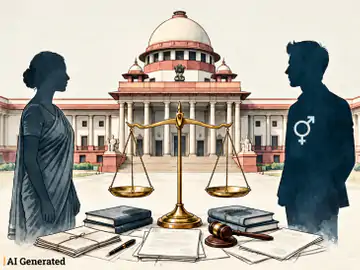
New Delhi/Alive News: The Supreme Court has issued a notice to the Centre on a petition challenging provisions of the Transgender Persons (Protection of Rights) Act, 2019. The petition raises questions about whether a person recorded as male at birth who undergoes gender-affirming surgery and identifies as a woman can claim rights and benefits reserved for women.
Women’s Declaration International India has challenged Section 7 of the Act and Rule 7 of the corresponding rules. These provisions deal with the change of gender identity in official documents following surgery.
The organisation has argued that these provisions could affect the rights and protections provided to biological women. It has also sought a review of the Supreme Court’s 2014 NALSA judgment, which recognised transgender people’s right to legal recognition of their gender identity.
During the hearing on October 28, the Bench discussed the legal distinction between transgender women and biological women in the context of rights and benefits reserved for women.
Petition Claims Surgery Does Not Change Biological Sex
The petitioner organisation has argued that recognising gender identity in official documents could affect women-specific constitutional and legal protections, including reservations and access to certain facilities.
The petition states that medical or surgical procedures do not change a person’s biological sex, chromosomes or genetic makeup. It argues that legal provisions based on gender identity could create questions about eligibility for benefits specifically designed for women.
What Happened During the Hearing?
Senior advocate Amit Sibal, appearing for the petitioner, said the case primarily concerned the rights of biological women. He argued that protections and benefits created for women should not be undermined.
Solicitor General Tushar Mehta told the court that the Centre was preparing its response to the main group of petitions and that the reply to this petition would also be included. He suggested that the issue could be left to the legislature.
Justice Joymalya Bagchi observed that the legislature had not settled the issue. During the discussion, the Bench also considered questions relating to childbirth and the distinction between transgender identity and biological sex.
Justice V. Mohana offered a different observation on whether transgender people could give birth, prompting the Solicitor General to clarify that transgender women cannot give birth.
Mehta also raised concerns about participation in women’s sporting competitions. He argued that allowing a person recorded as male at birth to compete in the women’s category could raise questions about physical advantages and fairness in sports.
Petition Cites Court Rulings on Women-Reserved Opportunities
The petition refers to several court judgments and administrative decisions concerning women’s reservations, recruitment to gender-specific posts, sports and access to gender-specific spaces.
- Anjali Guru Sanjana Jaan vs Maharashtra government: The Bombay High Court reportedly held that a person recorded as male at birth but identifying as a woman could contest an election from a panchayat seat reserved for women.
- Kerala State Election Commission decision: The petition refers to a November 2025 decision allowing transgender candidates Amaya Prasad and Arunima M. Kurup to contest local-body elections from seats reserved for women.
- Hina Haneefa vs Kerala government: The Kerala High Court allowed a transgender woman to join the Girls’ Division of the National Cadet Corps (NCC).
- S. Mani vs Additional Chief Secretary, Government: The petition cites a Madras High Court case in which the court reportedly directed the state government to appoint the petitioner to a vacant nursing assistant post reserved for women.
- Anamika vs Government of Kerala: The Kerala High Court reportedly permitted a person recorded as male at birth but identifying as a woman to compete in the women’s category at a district-level judo championship.
The Supreme Court’s proceedings will examine the legal questions raised by the petition and the Centre’s response to the challenge. The case concerns the relationship between transgender people’s legal recognition of gender identity and the protections and benefits specifically provided to women.